

In the wake of loss, those of us who remain find ourselves standing at the edge of an abyss we never imagined we would face. The pain is disorienting. The questions are relentless. And well-meaning voices around us, sometimes even within the church, often try to offer comfort through a framework that was never designed for the journey we are actually walking.
This is written for those who are grieving, for those who walk alongside the grieving, and for the church community that seeks to love well in the midst of incomprehensible loss.
The Misunderstood Framework: Kübler-Ross and the Stages of Dying
When Elisabeth Kübler-Ross introduced her five stages, denial, anger, bargaining, depression, and acceptance, in her groundbreaking 1969 book “On Death and Dying,” she was describing the emotional journey of people who were dying themselves. She observed terminally ill patients as they faced their own mortality.
Yet somewhere along the way, these stages became the dominant cultural framework for understanding grief itself, the experience of those left behind after a death. This fundamental misapplication has caused immeasurable harm to grieving people.
Here’s the critical distinction: Kübler-Ross was mapping the journey toward accepting one’s own death, not the ongoing, non-linear process of living with loss. When we impose this framework on bereaved individuals, we create false expectations:
- That grief moves in predictable stages
- That there is a clear endpoint called ‘acceptance’
- That moving backward means failure
- That grief has a timeline
- That healing follows a formula
But grief doesn’t work that way. And when we tell grieving people it should, we add shame to their suffering.
How Society and the Church Short-Change Grief
In our fast-paced, fix-it culture, we are deeply uncomfortable with prolonged pain. We want healing to be efficient, grief to be tidy, and emotions to be manageable. This discomfort manifests in phrases we’ve all heard, or perhaps even said:
- “They’re in a better place now.”
- “God needed another angel.”
- “At least they’re not suffering anymore.”
- “Everything happens for a reason.”
- “You need to move on.”
- “It’s been [X months/years]; shouldn’t you be over this by now?”
While often spoken with good intentions, these words communicate a dangerous message: “Your grief makes me uncomfortable, so please resolve it quickly.”
The church, which should be a sanctuary for the brokenhearted, sometimes becomes complicit in this rushed healing. We offer theological platitudes instead of presence. We quote Romans 8:28 when what’s needed is Romans 12:15, to weep with those who weep. We encourage premature ‘victory’ over grief when God Himself is not rushing the grieving person.
As we see in Scripture, God meets Elijah not with a sermon about his theological failings, but with rest, food, and gentle presence. Before the whisper, before the renewed mission, there was care for the body and soul. God’s first response to Elijah’s collapse was not to fix him; it was to be with him.
A More Honest Map: The Grief Map
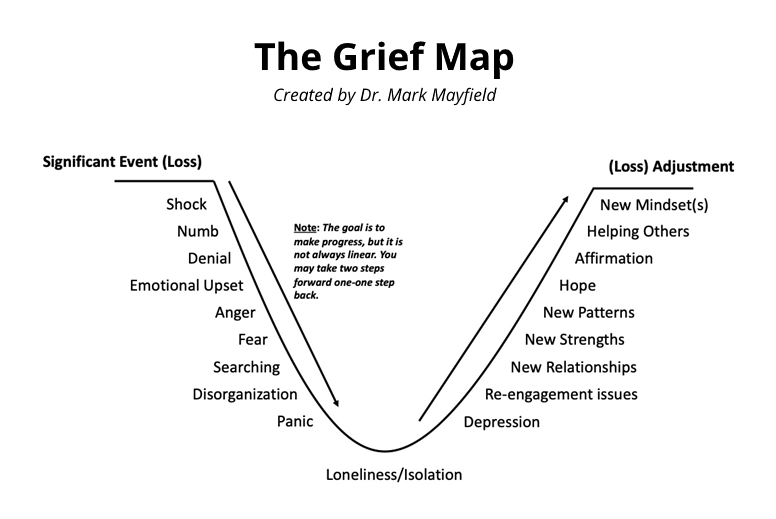
Unlike the linear stages model, the grief map more accurately reflects what grieving people actually experience. It acknowledges that grief is not a mountain to climb and conquer, but a spiral we walk through, sometimes making progress, sometimes circling back, but always moving forward, even when it doesn’t feel that way.
The grief journey includes:
- Shock and numbness: the initial protective response
- Denial: difficulty accepting the reality
- Emotional upset: the full weight of loss begins to settle
- Anger and fear: normal, necessary responses to injustice and vulnerability
- Searching: the longing to find what was lost
- Disorganization and panic: when familiar structures fall apart
- Loneliness and isolation: the deep awareness of absence
- Depression: not clinical depression necessarily, but profound sadness
- Re-engagement struggles: difficulty returning to ‘normal’ life
But the grief cycle doesn’t end there. With time, support, and the Spirit’s healing work, grieving people can experience:
- New relationships: connections that honor both past and present
- New strengths: resilience forged in the fire of loss
- New patterns: ways of living that integrate the loss
- Hope: not denial of pain, but confidence in God’s presence within it
- Affirmation: discovering meaning and purpose again
- Helping others: using one’s own suffering to comfort others (2 Corinthians 1:4)
Critically, this map is not linear. As the grief model notes, “The goal is to make progress, but it is not always linear. You may take two steps forward and one step back.” This is not failure: this is normal. This is human. This is holy.
The Theology of Sacred Suffering
Scripture does not shy away from the reality of suffering. In fact, it validates the full range of human grief:
- David cried out from the depths of despair (Psalm 42)
- Jeremiah wished he had never been born (Jeremiah 20:14-18)
- Job questioned God from his ash heap (Job 3)
- Jesus wept at Lazarus’s tomb, even knowing He would raise him (John 11:35)
- Paul despaired of life itself (2 Corinthians 1:8)
These are not spiritual failures. These are honest expressions of human anguish, preserved in Scripture for our comfort and instruction. God does not condemn the cries of the suffering; He enters into them.
The Apostle Paul, writing from prison, gives us this powerful truth: “For I am convinced that neither death nor life, neither angels nor demons, neither the present nor the future, nor any powers, neither height nor depth, nor anything else in all creation, will be able to separate us from the love of God that is in Christ Jesus our Lord” (Romans 8:38-39).
Not even depression. Not even burnout. Not even fear. Not even shame. Not even suicide. Nothing can separate us, or our loved ones, from God’s love.
What Grief Requires of Us
If we are going to honor the grief journey, both our own and others’, we must:
Give permission for the full range of emotions. Anger at God is not blasphemy; it’s a relationship. Despair is not faithlessness; it’s honesty. Numbness is not coldness; it’s protection.
Resist the pressure to ‘move on.’ You don’t ‘get over’ significant loss. You learn to carry it, to integrate it, to let it reshape you into someone who can hold both sorrow and joy.
Acknowledge the non-linear nature of healing. There will be good days and devastating days, sometimes in the same hour. This is not regression; this is reality.
Tend to the body as well as the soul. Like Elijah under the broom tree, sometimes the most spiritual thing you can do is eat, sleep, and rest. Self-care is not selfish; it’s stewardship.
Seek meaning, not just relief. Viktor Frankl, who survived Nazi concentration camps, wrote: “Those who have a why to live, can bear almost any how.” In time, meaning emerges, not to justify the loss, but to carry you through it.
Remember, you are not alone. God whispers in the darkness: You are not abandoned. You are not finished. Your story is not over.
✉️ Looking for Support?
Get compassionate articles on grief, mental health, and faith delivered each month to your inbox.
A Word to the Church
If we are to be the body of Christ to those who grieve, we must learn to sit in the ashes with them. We must resist our discomfort with ongoing pain. We must stop offering quick fixes and cheap comfort.
Here’s what grieving people need from us:
- Presence, not platitudes
- Permission to grieve without a timeline or judgment
- Prayers that acknowledge pain, not just pray it away
- Practical support for the long haul, meals, childcare, errands, and companionship
- Remembrance of their loved one, speaking their name with love
- Space to be angry, to question, to doubt, to collapse
- Reminder that they are held by a love that will not let them go
The God who met Elijah in the wilderness with bread and water meets us here, too. Not with shame. Not with judgment. But with care, presence, and an invitation to the next step, however small it may be.
The Journey Ahead
If you are in the depths of grief right now, please hear this: You do not need to be further along than you are. Your tears are not a lack of faith. Your questions are not blasphemy. Your exhaustion is not weakness.
You are walking a path that cannot be rushed. And the God who created you, who knows every hair on your head and every tear you’ve cried, is walking it with you. Not ahead of you, demanding you keep up. Not behind you, disappointed in your pace. But beside you, matching your stride, holding you up when you stumble, and whispering:
“You are not alone. You are not abandoned. Your story is not over.”
The journey of grief is sacred. It is holy ground. And we who walk it, or walk alongside those who do, must take off our shoes and honor every step.
May God’s peace, which transcends all understanding, guard your hearts and minds in Christ Jesus. And may you know, deeply and truly, that nothing, absolutely nothing, can separate you from His love.
Written with deep compassion for those who grieve, by Dr. Mark Mayfield, Clinical Director, PhD, NCC, LPC

You Don’t Have to Walk Through Grief Alone
Whether you’re carrying fresh loss or long-held sorrow, compassionate, faith-centered support is here to meet you where you are. Let us find you a Christian counselor who will compassionately walk with you toward hope.